

Full Grain Leather Wallet: Why It's the Only Kind Worth Carrying
Here in my Alabama workshop, I've built a lot of wallets. Bifolds, cardholders, slim front-pocket designs — you name it. And after years of working with leather, one thing I'll tell you straight: if your wallet isn't full grain, you're leaving quality on the table.
Every guy carries a wallet. Most people grab whatever's cheap, toss it in their back pocket, and replace it every year or two when it starts falling apart. I get it. But if you've ever held a real full grain leather wallet — felt the weight of it, run your thumb across that tight grain, watched it darken and soften over years of daily carry — you understand why some things are worth doing right the first time.
This post breaks down everything you need to know: what full grain leather actually is, why it matters, what separates a great men's leather wallet from a disposable one, and how to find something built to last a lifetime. Whether you're buying for yourself or looking for the perfect personalized leather wallet as a gift, you're in the right place.
What Is Full Grain Leather? (And Why It Matters)
Most people hear "genuine leather" and think they're getting the real thing. They're not.
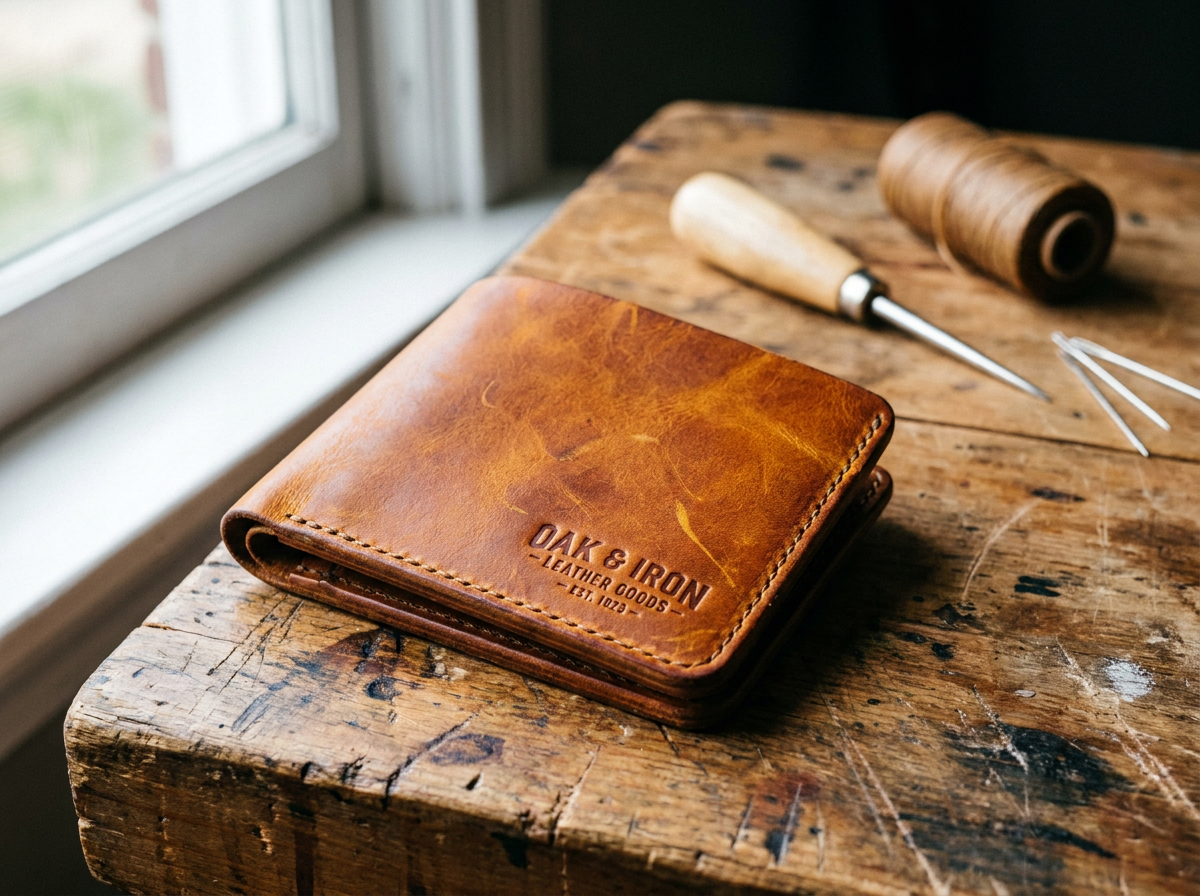
Full grain leather is the top layer of the hide — the part right underneath the animal's outer skin. It's the densest, tightest, most durable part of the hide. The natural grain, the pores, the slight imperfections are all there, and they tell the story of a life well lived. Nothing's been sanded off or buffed away. It's the first cut, and it shows.
When a tannery gets a hide, they start from the top. Full grain is what you get when nothing's been corrected. Everything below that is a lower grade — and every step down the ladder means less durability, less character, and less value for your money.
Full Grain vs. Top Grain vs. Genuine Leather: Know the Difference
This trips a lot of people up, so let me lay it out plainly:
- Full grain leather: The real deal. No sanding, no buffing, no surface coating to hide natural imperfections. This is the most durable type of leather available and the only kind that develops a proper patina over time.
- Top grain leather: The second layer, after the outer surface has been sanded to remove natural marks and achieve a uniform look. It's more consistent in appearance, but you've sacrificed density and durability in the process.
- Genuine leather: Don't be fooled by the word "genuine." This refers to multiple lower-grade layers bonded together. It feels like leather at first, but it cracks and peels within a year or two.
- Bonded leather: The bottom of the barrel — leather scraps glued together with a polymer binder. Avoid it entirely.
When someone hands you a wallet and it feels stiff, plasticky, or perfectly uniform without a single natural mark, that's a clue. Real full grain leather has texture. It has character. And it only gets better with time.
The Patina: What Sets Full Grain Leather Apart
Here's the thing that truly separates full grain from everything else: patina.
As you use a full grain leather wallet every single day — the friction, the oils from your skin, the heat from your pocket — the leather responds. It darkens in the spots you touch most. It softens and molds to your carry style. Within a year, that wallet becomes uniquely yours in a way no factory product ever could.
Top grain and genuine leather don't do this. They fade, crack, or peel instead. Full grain ages the way good boots age, the way a favorite leather chair ages — it gets richer and more beautiful over decades of real use. That's not just a selling point. That's leather chemistry.
What to Look for in a Full Grain Leather Wallet
Not all full grain leather wallets are made equal. Here's what separates a wallet you'll carry for 20 years from one that falls apart in 20 months.
The Leather Source: Vegetable Tanned vs. Chrome Tanned
Full grain leather is still processed — the raw hide has to be tanned to stop decomposition and make it workable. There are two main methods:
Vegetable tanning is the traditional method. Hides are slowly processed using natural plant-based tannins — oak bark, sumac, chestnut. The process takes weeks. The result is firm, dense leather that molds and develops patina beautifully over time. It's the gold standard for traditional leathercraft and the only type I use for my wallets.
Chrome tanning is faster and cheaper — done with chemical salts in a matter of hours. It produces a softer, more pliable leather out of the gate, but it doesn't develop the same depth of patina. For a wallet you intend to keep for life, vegetable tanned full grain leather is the right choice.
I source my leather from Springfield Leather Supply and Tanners Row, both of which carry consistent, high-quality veg-tan hides. When the material is right, everything else is easier to get right too.
Hand-Stitching vs. Machine Stitching
Look closely at the thread on any leather wallet. Machine stitching uses a lockstitch — one thread interlocked with a second from beneath. When that stitch breaks anywhere along the seam, it runs. The whole seam can unravel from a single failure point.
Saddle stitching — done by hand with two needles and a single continuous thread — doesn't have that failure mode. If one stitch breaks, the rest hold independently. It takes longer. It costs more. But it's the only kind of stitching that belongs on a wallet built to last.
Every handmade leather wallet I build at Fox Tree Creations is saddle stitched by hand. No shortcuts.
Edge Finishing
The edges of a leather wallet tell you a lot about the builder's standards. Properly finished edges — burnished smooth with a bone folder and beeswax, or edge-painted with multiple coats — prevent cracking, fraying, and moisture absorption. Lazy edge work is one of the most common shortcuts in mass-produced wallets, and one of the first things to fail.
Thickness and Construction
A slim leather wallet is great, but there's a right way and a wrong way to achieve slim. Skiving — thinning the leather at seam overlaps so layers lay flat — is a skill that takes practice. Done right, you get a slim, elegant profile without sacrificing structural integrity. Done wrong, the skived areas become weak points that blow out within months.
Best Full Grain Leather Wallet Styles for Men
The right wallet depends on how you carry and what you're carrying. Here's a breakdown of the main styles worth considering.
The Classic Bifold Leather Wallet
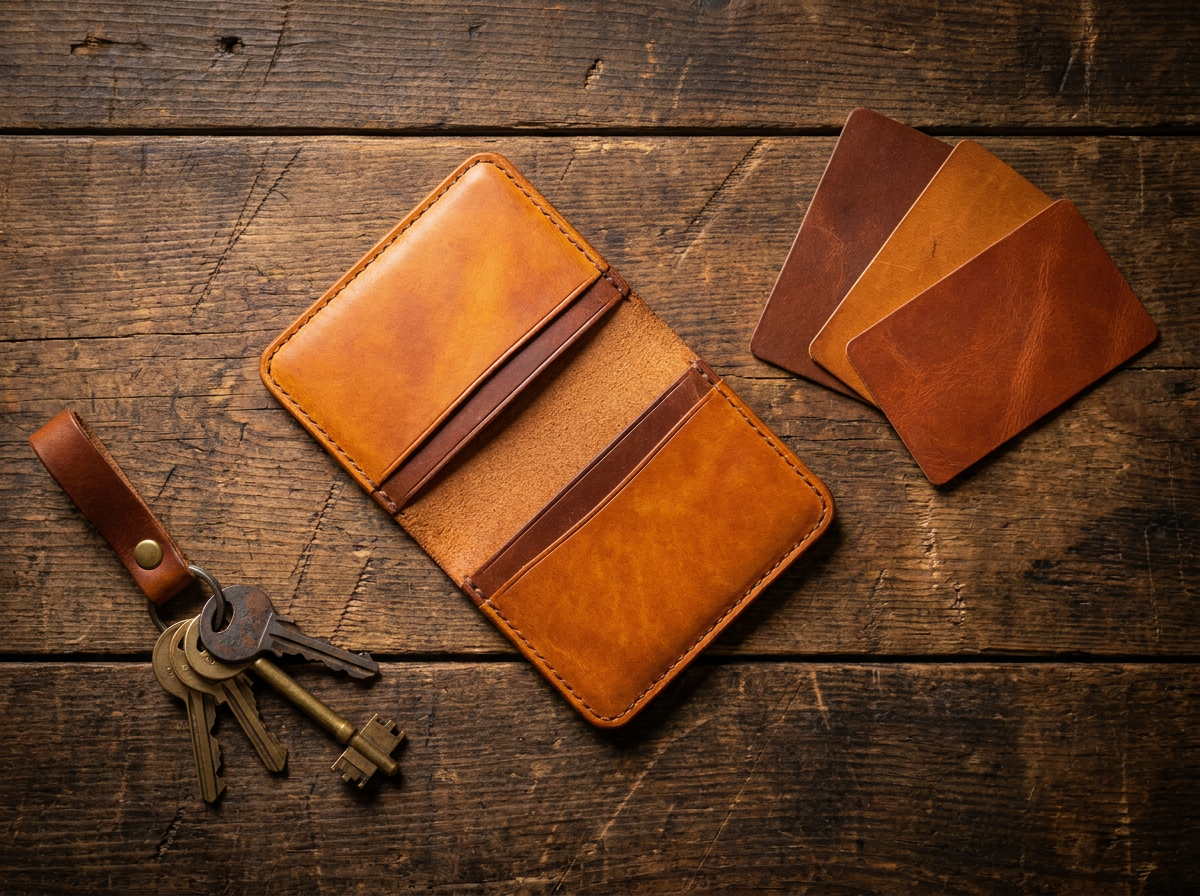
The bifold is what most guys picture when they think "wallet." Folds in half, cash sleeve in the center, card slots on both sides. It's the workhorse — proven, practical, and timeless.
A well-made bifold leather wallet in full grain should hold 4–8 cards and folded bills without being so thick it bulges awkwardly. The key is card slot tension — too loose and cards fall out, too tight and the leather cracks from repeated stress. That tension needs to be dialed in during the build, not adjusted after the fact.
My bifold wallets are built from a single piece of veg-tan full grain, hand-cut and saddle stitched with waxed linen thread. The card slots are pre-broken-in during the build so you're not wrestling stiff leather from day one.
The Slim Minimalist Card Wallet
If you've gone mostly cashless — most of us have — a slim leather wallet is the move. A minimalist cardholder carries 3–5 cards and sits flat in your front pocket. You barely notice it's there until you need it.
The slim design actually puts even more emphasis on leather quality and stitching, because there's nowhere to hide sloppy workmanship. The leather has to be cut clean, the edges properly finished, and the card slots precisely sized. A slim wallet built wrong fails fast. Built right, it's the last wallet you'll ever need.
Personalized and Custom Leather Wallets
Here's where things get personal — and this is one of my favorite parts of the work.
A personalized leather wallet takes a useful object and turns it into something meaningful. I've done wallets with initials and monograms, names and dates, state outlines, patriotic designs, and custom logos for corporate gifts. The laser engraving I do is permanent — it doesn't fade, peel, or wear off. It's as permanent as the leather itself.
If you're shopping for a custom leather wallet as a gift — birthday, anniversary, graduation, Father's Day — personalization is what makes it something the person actually keeps. Not in a drawer. In their pocket, every day.
You can browse our handcrafted leather wallets to see what's currently available. If you have something specific in mind — a custom design, initials in a particular font, a special date — reach out and we'll build it.
The Front-Pocket Slim Wallet
Similar to a cardholder but designed with an angled or quick-access slot for single-hand retrieval. A smart choice for guys who prefer front-pocket carry and want something that won't shift around or add bulk. Works especially well with a money clip addition for those who still carry cash.
Why Handmade Beats Factory-Made Every Time
Let me be honest with you about something.
You can buy a "leather" wallet at any big-box store for $12. And I understand the appeal. But here's what you're actually getting:
- Bonded or genuine leather that peels and cracks in 12–18 months
- Machine-cut, machine-stitched, zero human attention paid to each individual piece
- Edges finished with cheap plastic coating that chips off under daily use
- A product engineered to a price point, not built to a standard
- No history, no story, no character
A quality handmade leather wallet built from full grain hide costs more upfront. But a quality wallet lasts 10, 20, 30 years. When you divide the cost over the life of the product, the math isn't even close. The cheap wallet is the expensive choice in the long run.
Beyond durability, there's something else that matters: intention. When I cut, skive, stitch, and finish a wallet, I'm paying attention to that one piece. I check the grain direction, the thread tension, the edge work. I care about what leaves my workshop because my name is on it. That's something a factory line doesn't offer — and genuinely can't.
How to Care for Your Full Grain Leather Wallet
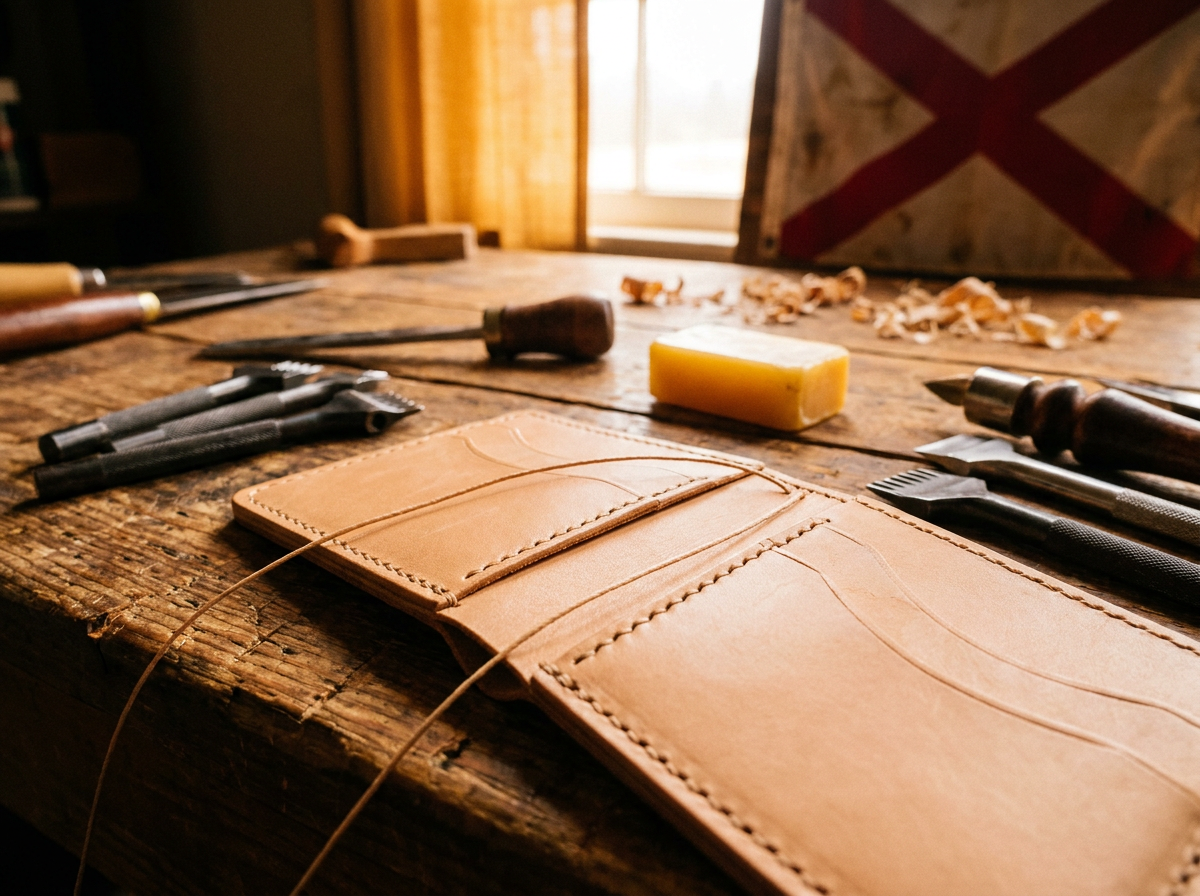
A well-made full grain leather wallet doesn't need much maintenance. But a little care goes a long way toward keeping it in great shape for decades.
Conditioning
Full grain leather can dry out over time, especially in dry climates or with frequent exposure to heat. Use a quality leather conditioner — I recommend Leather Honey or Bick 4 — every 6–12 months. Apply a small amount with a soft cloth, work it into the leather, and let it absorb overnight. It keeps the leather supple and prevents cracking along fold lines.
Water and Moisture
Full grain leather handles light moisture better than lower grades, thanks to the natural oils present in the hide. If your wallet gets wet, shake off the excess water and let it dry naturally — away from direct sunlight or heat sources like a radiator. Don't stuff it back in a pocket while still damp, as the leather can warp while it dries under pressure.
Embrace the Patina — Don't Fight It
This is worth repeating: the darkening, the softening, the subtle marks from daily use — that's not damage. That's the leather doing exactly what full grain leather is supposed to do. A wallet that shows years of carry is a wallet that's been lived in. It's a feature, not a flaw. Lean into it.
Breaking In a New Wallet
New vegetable tanned leather wallets will feel stiff out of the box. That's normal — it's a sign of quality, not a defect. Use it every day for a few weeks and it'll soften naturally with body heat and friction. A light conditioning before first use can speed this up slightly. Don't try to force it open by overstuffing it from the start — let it break in gradually and it'll end up shaped perfectly for your carry.
Where to Find a Full Grain Leather Wallet Worth Keeping
You have options across a pretty wide price range. Here's how I'd think about it:
Mass-market leather brands: Some well-known brands like Saddleback Leather make solid full grain products. Expect to pay $100–$200 for something genuinely full grain from a name brand. You're partly paying for marketing, but the quality is often there.
Marketplace sellers (Etsy, Amazon Handmade): Quality varies wildly. Look specifically for sellers who state "full grain vegetable tanned leather" and show their process. Read reviews with an eye toward longevity — not just how it looks on arrival.
Small-batch American craftsmen: This is where you get the best value for your money in terms of quality, customization, and the assurance that a real person built your wallet with real attention. No offshore production. No shortcuts. Just craft and accountability.
At Fox Tree Creations, I build every wallet by hand here in my Alabama workshop using full grain veg-tan leather sourced from quality American tanneries. Each piece is made to order — yours is built for you, not pulled off a shelf. And because I do my own laser engraving in-house, personalization is easy to add without outsourcing or delays.
Whether you want a classic bifold leather wallet, a slim everyday cardholder, or a custom leather wallet with personalized engraving, you'll find options in our shop. And if you want something you don't see listed, reach out — custom builds are a big part of what I do.
Shop handcrafted leather wallets at Fox Tree Creations →
The Bottom Line
A full grain leather wallet isn't just a place to keep your cards and cash. It's something you carry every single day, reach for dozens of times, and — if it's built right — hand down to a son or grandson who asks where you got it.
Skip the bonded leather. Skip the "genuine leather" marketing spin. Get something made from real full grain hide, hand-stitched by someone who gives a damn about what they build.
That's what I make here in Alabama. And I think once you hold one, you'll understand exactly what I mean.
Jason Arnett is the founder of Fox Tree Creations — an Alabama workshop specializing in handcrafted full grain leather goods and laser-engraved personalized gifts. Every piece is made to order, one at a time.

0 comments